June 7, 2013

My Newest EDC Light: EagleTac D25A Mini

I don't know why it's taken me so long to write a post about a flashlight. I paid lip service to my Photon X-Light Micro and FourSevens Preon P1 flashlights in a previous post, but I didn't really say much about them. So, before I get to the EagleTac D25A Mini, I'll give a quick flashlight backstory.

The Photon X-Light Micro was the best thing I acquired in 2011. It still resides on my keychain, with the original battery alive and kicking. I use it almost every day; it's just great to have on my keychain. I have the high-tech looking clear version, which has a glow in the dark button. Max output is 4.5 lumens according to Photon, which is sufficient for my intended use cases: finding keyholes; navigating hallways at night; and reading menus in dark restaurants.


I tend to use the Photon's simple click-on, click-off mode. The click button, however, can also be manipulated to provide a variable output level and to select different beacon and SOS modes - pretty impressive for a nine dollar light. The Photon is very well made, too. The plastic case, the split ring and the keychain clip are all very tough, and they appear to be designed to withstand the daily abuse of keychain carry. I now have one of these lights on every one of my keychains.


Next up, the FourSevens flashlight. I purchased the Preon P1 for use as my daily pocket-carry light, and it works just great for that purpose. According to FourSevens, it is only 2.95 inches long and only 0.6 inches in diameter. It's pretty small, and it really disappears in the pocket.


The Preon is powered by a single AAA battery, and it has a max output of 70 lumens. It has a standard twisty head UI that can be used to select low (1.8 lumens), medium (8.5 lumens), and high (70 lumens) output modes. Flashlight geeks will appreciate that the Preon uses a Cree XP-G2 LED; and, yes, many people care about such specs. The UI can also be manipulated to access the "special" strobe, beacon, and SOS modes (which I only use when I want to be annoying or when I'm demonstrating the features to someone).

I Can See The Cree!
I love the easy-to-use twisty UI and the basic design of the Preon. My only gripe: the finish is too silky smooth, which makes it difficult to twist on and off with one hand. I wish it had some texture or knurling at the head.

The Preon P1 And Its Power Source
End of backstory. So what's up with the EagleTac D25A Mini? To be honest, I simply wanted to buy another flashlight. No big deal. I initially looked at other AAA lights, but soon decided on a AA light. I also considered the following AA lights before deciding to acquire the EagleTac: Maratac; Lumapower LM31; FourSevens Mini MA; and EagleTac D25A Clicky. I was about to order the titanium clicky version of the D25A, but then common sense and frugality took over.


The D25A is very small and compact. The EagleTac website tells me that the D25A is 3.1 inches long with a head diameter of only 0.69 inches. It's not that much larger than my Preon, and it also fits nicely into my pocket. I feel that the AA size of the D25A is a perfect compromise between utility and EDC capability.

D25A Mini (Top), Preon P1 (Bottom)
The flashlight has a solid and tough pocket clip that I'll never use for its intended purpose (mine is black versus the silver colored clip shown on the EagleTac website; what's up with that?). The D25A also came with a belt holster (that I'll never use) and a lanyard with clip (that I'll never use). The end of the D25A has a slot to accommodate the lanyard clip; this allows tailstanding when the lanyard is attached.

D25A Mini (Left), Preon P1 (Right)
The EagleTac D25A is compatible with AA sized batteries, including standard alkaline batteries, long life disposable lithium batteries, rechargeable NiMh batteries, and high voltage lithium ion batteries (which may result in blinding sunlight output and molten aluminum, which equals awesome). I'm using a regular AA cell at the moment, and it works just fine. I've read that better performance can be had with a Sanyo Eneloop battery, and I will give that a shot next. The housing is not much larger than the AA battery itself, as shown here:


Now, I supposedly ordered the latest and greatest version of the D25A, i.e., the one with the Cree XP-G2 R5 LED. According to the marketing department of EagleTac, this emitter generates 179 lumens on high, 47 lumens on medium, and 5 lumens on low. I am not an LED expert, nor do I care to become one. I only know these facts: this flashlight generates plenty of light for my EDC needs; the low mode is great for skulking around the house at night; and the color of the light is more of a natural and warm hue (in contrast to the Preon P1, which seems to be "cool white" in comparison).

Cree XP-G2 R5 LED
The light uses the same type of twisty UI as the Preon P1, so it was easy for me to learn how to use it. The D25A Mini also has some "hidden" modes for strobe, beacon, and SOS. I guess these modes could be useful in certain urban emergency scenarios (flagging down the car valet at the five-star hotel, signaling for help when your mountain bike tire goes flat on the golf cart path, indicating that you've raised the bid on that rare bottle of wine, etc.). Speaking of the twisty interface, EagleTac was kind enough to provide ample knurling on the body and head of the flashlight. The knurling, combined with the protruding pocket clip, makes it very easy to operate the twisty UI with one hand. For this reason, I'll be carrying the D25A Mini more often than the Preon P1.

Grip It & Twist It
So that's about it for the EagleTac D25A Mini. If and when I NEED another flashlight, I'll keep the EagleTac brand in mind.

May 30, 2013

"Premium" Writing Paper (Clairefontaine & Rhodia)

I think that I've completed the basic kit for a fountain pen newbie. Fountain pen: check. Converter: check. Ink samples: check. Another fountain pen: check. Bottle of ink: check. The last item in the fountain pen 101 kit? Fountain pen friendly writing paper! Really. I'm serious:


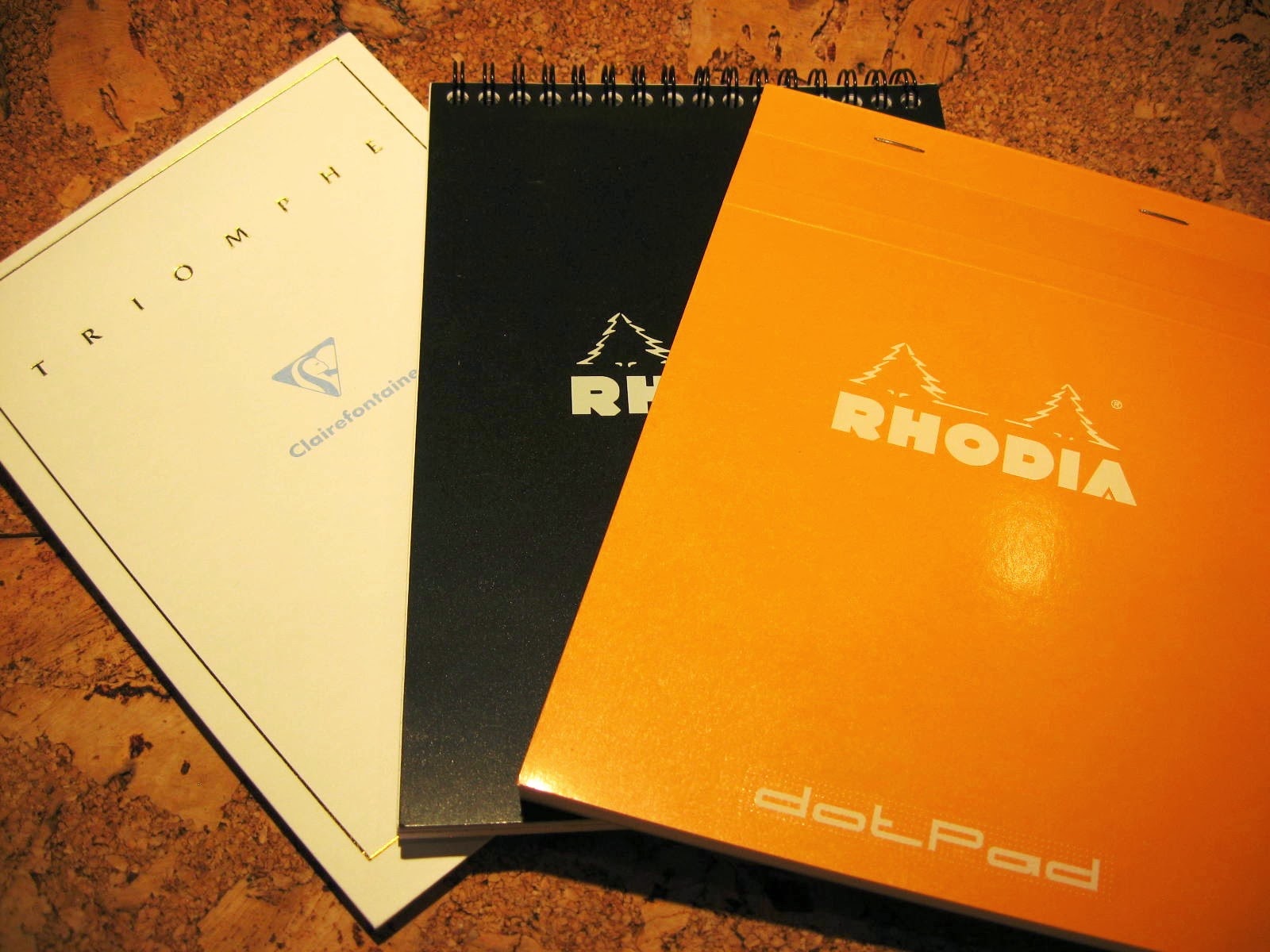
Left to right: Clairefontaine Triomphe writing pad; Rhodia Dot Pad (spiral bound); and Rhodia Dot Pad (staple bound). They are all A5 size, and they all contain really nice paper. Serious reviews of these writing pads can be found all over the Internet, and anything I try to write will be redundant. Personally, I like the feel of the Triomphe paper the best, but I don't like the way that the pages are glued at the top . . . tearing the pages away cleanly can be hit or miss. I prefer the micro perforations on the Dot Pads much better in this regard. The Triomphe paper has lavender or purple-ish colored lines, which are impossible to accurately show due to poor lighting, color balance, and bush league photography skills:

Clairefontaine Triomphe
The Dot Pad paper uses a grid of dots instead of lines. Official specs say that the dots are printed with a 5 mm pitch. I like the dots:

Rhodia Dot Pad
To be honest, my fountain pens work just fine on the standard office copy paper that I use. That said, they write smoother and produce higher quality ink lines on these premium paper products. Even if you don't write with fountain pens, you should try some of this paper just for the experience. You only live once.

By the way, I also acquired a tiny Rhodia pad (No. 10 size, 2 x 3 inches) and feel that it's just too small to be really useful. I also bought one in the No. 11 size, which is 3 x 4 inches. The No. 11 size is perfect for quick notes, to-do lists, reminders, and miniature paper airplanes. I use the No. 11 pad more than the A5 size pads shown in the pictures.

To summarize: I now have fountain pens, converters, ink, and good writing paper. I think my kit is complete. Too bad my handwriting sucks.

May 23, 2013

Pocket Knives

My recent bout of KAD (Knife Acquisition Disorder) is somewhat under control now. I have accumulated an acceptable collection of knives, and I'm not really itching to make another purchase just yet. Of course, I'd love me one of those Chris Reeve Sebenza knives, but the price tag keeps my fiscally responsible side well-grounded in reality. I don't think that last sentence makes sense, so let me rephrase it: I can't afford it.

When I was a wee lad I carried a pocket knife to be cool, carve my initials into wooden objects, and play mumblety-peg with the neighborhood degenerates. I recall having a cheap single blade folder and a medium sized Swiss Army Knife way back when. However, I stopped carrying pocket knives after getting out of high school (yeah, back then pocket knives were allowed in school), and never really missed them or gave them much thought until a few years ago.

So what happened a few years ago? I was on a weekend hike with another family, and my friend broke out an absolutely enormous Swiss Army Knife that I immediately ridiculed and scoffed at. No, it wasn't THIS monstrous, but still. After getting my friend on the defensive, he explained all about the practical utility of having an EDC pocket knife: sawing logs for a lean-to; spontaneous tooth picking; and blah blah emergencies blah blah. He was very convincing. So, I dug my old Swiss Army Classic out of my drawer and started to carry it on the regular. I soon decided to get something different, and that led to the acquisition of a Buck Scholar knife.

KAD took over in 2012, and I really went haywire that year. My knife purchases went like this: Spyderco Dragonfly2 in May; Spyderco Manix2 Blue Lightweight in June; Benchmade Mini-Griptilian in July; Coldsteel Tuff Lite in August; Gerber Dime in November (returned to Amazon in November); Leatherman Juice S2 in early December; and Spyderco Native5 ordered on December 31, 2012. Wow, that's a little overboard, but the lineup looks great:


The knives are shown in chronological order according to when I got them: top row left to right, then bottom row left to right. So my oldest knife is the SAK Classic, and my newest is the Native5. I don't really carry the Classic or the Scholar these days, simply because I prefer the other knives as EDC items. I rarely carry the Manix2 because I don't want to scare or intimidate any sheeple in the neighborhood. Seriously, the Manix2 is only a "pocket" knife in theory or if you're rockin' giant baggy MC Hammer pants.

I guess that I can do some retroactive posts related to the Dragonfly2, Manix2, and Mini-Griptilian knives. So be on the lookout for those posts. Unless, of course, KAD kicks in again and/or a Sebenza magically appears in my mailbox. If that happens, I'll write about it immediately.

May 15, 2013

Real Japan Blues 105BSP Jeans

A few months ago I was willing and ready to pull the trigger on some Momotaro 1005SP jeans, but couldn't decide (with 100% certainty) on the size. Moreover, I couldn't find any reputable domestic vendors, and wasn't too keen on the idea of buying them from a random Japanese website. As a result, I put those Momotaros on my wish list and moved on.

A few weeks after NOT acquiring the Momotaros (No-motaros?), I "coincidentally" found myself randomly wandering into a brick and mortar Self Edge store. I wasn't really looking to buy anything in particular, but I thought it would be a great opportunity to try some different jeans on to see if anything fit well. I tried on several different jeans, and decided buy the 105BSP jeans from Real Japan Blues (tagged size 30).

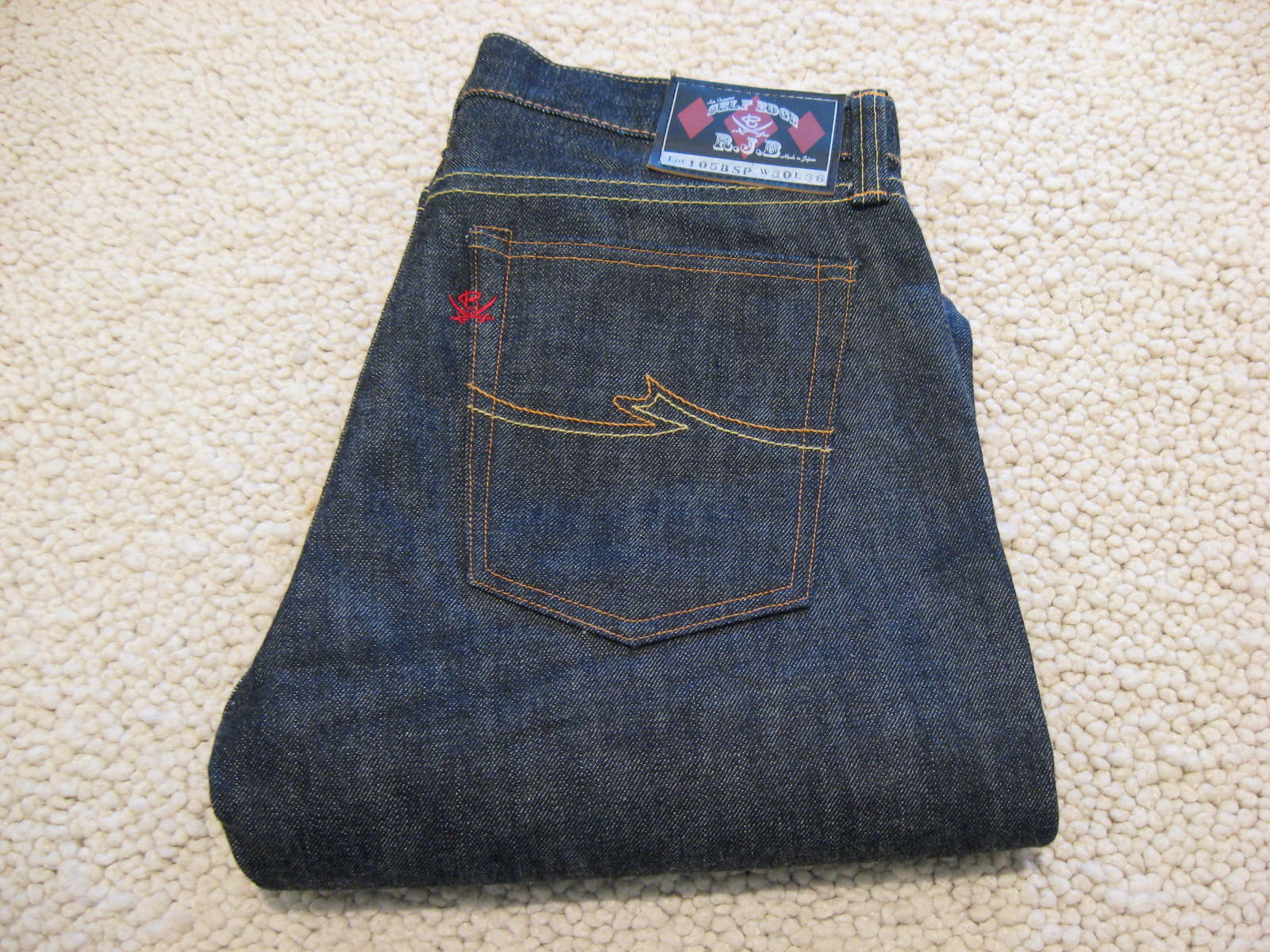
Brand New! No Soak, No Wash, No Nothing
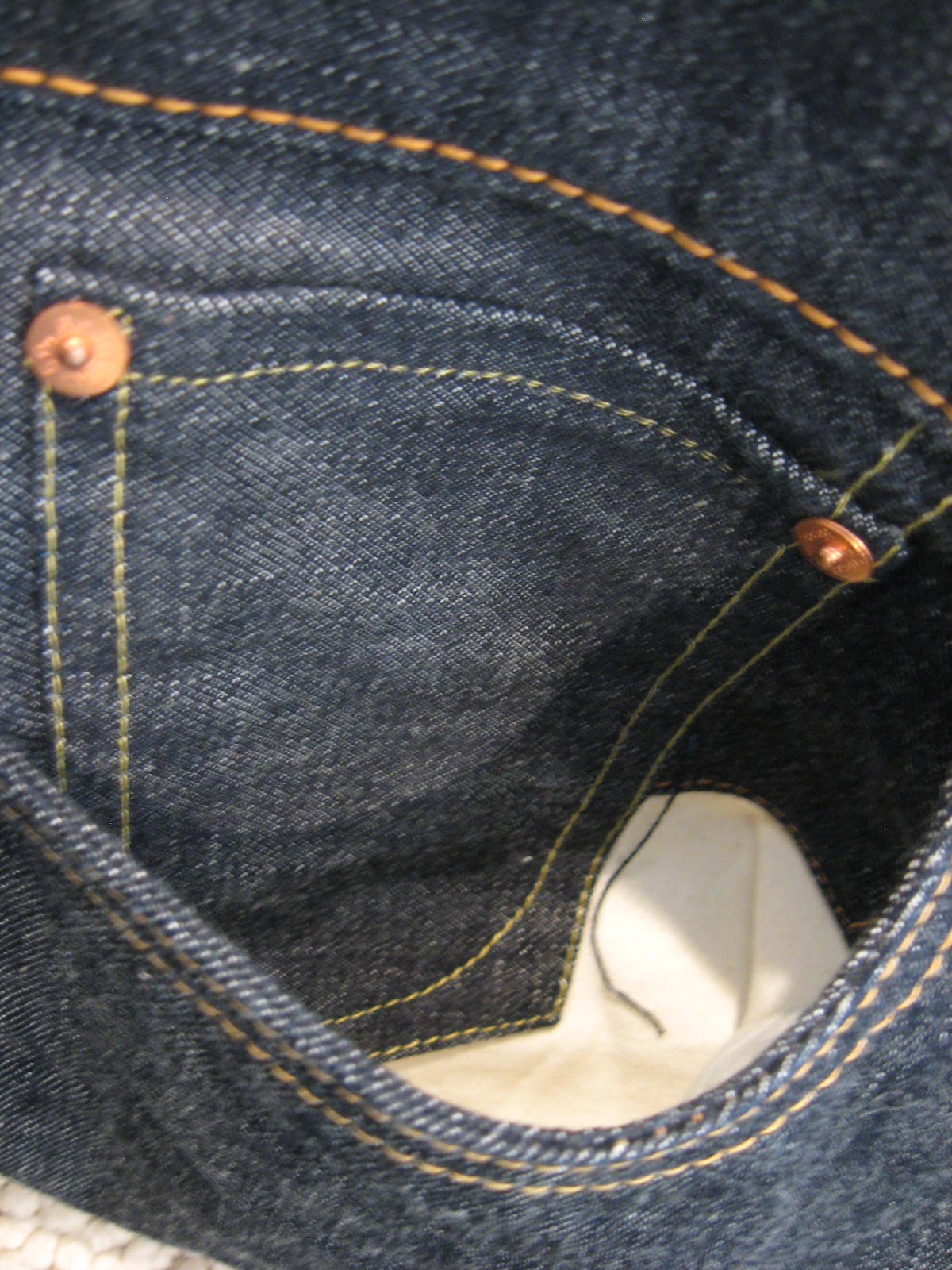
I like the cut of these jeans because the legs are far from skinny and because the all-important rise measurement is somewhat generous relative to my Roy jeans. The jeans have some cool details, too . . . super important features such as: different colored stitching on the back pockets; a sewn-in red "tag" on the back pocket; an extra deep knife/coin pocket; and doubled denim material along the front pocket openings. The as-new inseam measured 38 inches long! I had Self Edge cut off about five inches and hem them with the goal of having a 30 to 31 inch inseam after shrinking. Self Edge does a great job at hemming jeans, and they even use a vintage Union Special chainstitching machine to do the job right.

I Like These Arcuates

Red "Tag"

Deep Coin Pocket
Doubled Front Pocket Material
After the initial soak/shrink in the bathtub and hang dry, the 105BSPs were slightly on the stiff and crusty side. My understanding is that the post-soak stiffness is caused by the starch that is used during the manufacturing process. I wore them for the first time on January 1, 2013, and they broke in quickly after several wearings. If I'm honest, they were less than comfortable on the first day due to the stiffness.

Post-Soak Magic Pants!
I've been wearing these jeans at least a couple times per week, and they have become quite comfortable. I haven't washed them yet, and they haven't developed any distinctive fading effects or unique wear patterns yet. The sizing is very good, and Self Edge did a great job with the hemming by estimating and compensating for shrinkage of the inseam - the length is spot on. That said, the rise might be a little short, which means they are not a perfect fit. Oh well, I still have the Momotaros on my wish list.

May 6, 2013

My Son's Dragon Fountain Pen

I got my son into fountain pens at an extremely early age, and he's now learning how to do long division using his Pilot Varsity pens. He peers over my shoulder when I'm "researching" pen-related goods on the Internet, and he says things like: "I like that see-through one" and "Can I get a pen that has one of those piston things inside it?" and "I like dragons" and "You know, Dad, I think that the extra fine nib on your Pelikan M205 is slightly more forgiving than the fine nib on your Lamy Vista due to the higher gold content, but you really need to stop whining about the line width and shading variation and simply pony up the big bucks, step up to the plate, and acquire one of those awesome Nakaya pens". OK, the last quote is fake, but he really is very interested in fountain pens. Really.

Being the swell dad that I am, I soon put "dragon pen for kid" on my acquisition list. I found a few cheap and cheesy looking fountain pens with dragon designs on them, along with this outstanding work of art from Nakaya: The Gold Dragon. I wish that pen would magically appear in the mail some day, but it won't. Sorry, son, it won't happen.

One day while browsing the I Sell Pens website for nothing in particular, I caught a glimpse of something that looked like a pen with a snake motif. That seed led to a fountain pen with an Asian dragon motif, and I was all over it. The product description could have read "Dragon Pen For Kid" - it was/is perfect. I was extremely happy about the price point, and immediately clicked the BUY ME, YOU CAN'T RESIST button. A few short days later, and this beauty was delivered to me:


The design and overall look of this pen is exactly what I was hoping to find. Are the quality, workmanship, and choice of materials at the high end of the scale? Of course not. Does it look freaking awesome to a third grader? Hells yeah. Seriously, just look at Awesome Dragon #1 (he lives on the cap):


But wait, there's more. Feast your eyes on Awesome Dragon #2 (he resides on the body):


Let me say a few words about the pen itself. First, the pen is massive, thick, and heavy (it weighs about 105 grams with a full converter of ink). Second, the cap screws onto the body and cannot be posted. Third, it looks awesome. The pewter colored design and clip work very well with the glossy black finish of the cap and body.


I don't know who makes this pen, and don't really care. It came with a converter, and it is compatible with standard international sized ink cartridges. I assume that the pen is made in China or Taiwan, although the nib says "Iridium Point Germany" on it (according to I Sell Pens, the nib is a Medium-Fine).


To be honest, both my son and I really like how this pen writes. The nib size, which seems to write more like a Medium or Medium+ than the advertised Medium-Fine, and generous ink flow contribute to a nice user experience. The pen writes very smoothly, doesn't skip at all, and produces a consistent flow of ink once it starts going. The last caveat relates to my only complaint about the pen; I don't think the cap has a good seal because it tends to dry out if not used every day. In fact, it was difficult to start a few times, but ink flow was great once it began. We loaded the converter with Sailor Jentle Sky High ink for its maiden voyage, but have since retired the converter in favor of ink cartridges (which are easier for my son to use). Here is a scanned writing sample:


PS - I didn't want to spoil the kid with such a cool writing instrument, so I held onto the pen for a while before giving it to him as a gift. The smile on his face when he opened the box was priceless to me. It's his favorite pen at the moment (but I haven't shown him the Nakaya Gold Dragon yet).

April 27, 2013

Kinunu Coffee

Outside The Bag
I was in the Phoenix area recently, and had time to stop by one of the best coffee shops in Arizona: Cartel Coffee Lab. They roast their own coffee, pull decent shots of espresso, and know how to make a proper cup of pour-over coffee. Win, win, and . . . win. I ordered a macchiato and it was a PROPER macchiato, not one of those ridiculous milkshake like concoctions you'll get at Starbucks. I also picked up a bag of freshly roasted beans. I usually like African coffees, so I decided to buy the Kinunu coffee. The description on the label may be a little confusing to most sane people, but it's full of juicy details for coffee geeks.

Inside The Bag
I made a cup of this Kinunu coffee using my Clever Coffee Dripper, and the brew was outstanding. I really noticed the sweet candy-like aftertaste that remained well after drinking each sip. I'm happy that I bought a bag of this coffee, but I'm sad that I won't be able to acquire more without having to pay for shipping. I highly recommend this coffee, and highly recommend the roaster: Cartel Coffee Lab. Pay them a visit the next time you are in Arizona!

April 19, 2013

Pilot Custom Heritage 91 Fountain Pen

I acquired a Pilot Custom Heritage 91 fountain pen several months ago, but haven't had the time to write about it until now. At the time of acquisition, I really wanted to try a good Japanese nib, and I had my eye on the Pilot Prera fountain pen. After doing some research and over-analysis, however, my eye started to wander over to the higher quality Pilot pens, such as the Custom 74, the Custom 823, and the Custom Heritage 92. I accidentally learned about the Custom Heritage 91 model while reading up on the other Pilot models (the 91 is not readily available in the United States and there isn't a lot of published information about it). Long story short, I ordered one (in the Tsuki-Yo colorway) from a Japanese vendor, and am pleased to say the least. As the picture indicates, the nib is a 14 karat rhodium plated variety. I opted for a fine sized nib, assuming that it would write lines having a thickness similar to my Lamy extra fine and my Pelikan extra fine.

Although I was a little paranoid about ordering something from a Japanese website, the experience was painless and the pen arrived safely and with little overseas delay. The pen came packaged in a simple box, with one complimentary Pilot ink cartridge. Nice package, but I would have been OK with a plain cardboard box and a lower price.


I also ordered a Pilot CON-70 converter for the pen; the CON-70 employs a cool button vacuum mechanism that literally sucks in the ink. It's actually somewhat fun to use the CON-70. Really.

CON-70: Before Filling
CON-70: After Filling
My understanding is that the Custom Heritage 91 pen was released by Pilot in different colorways that match the color of some of Pilot's Iroshizuku inks: Tsuki-Yo (the blueish color of my pen); Yama-Guri (brownish); and Yama-Budo (reddish pink). The 91 also comes in a standard black body for those who like something more traditional.


I already had a sample of the Tsuki-Yo ink waiting for the pen, and it was nice to try the ink for the first time using its matching pen. I recently bought a full bottle of the Tsuki-Yo ink and plan to keep the 91 loaded with it. Pilot did a great job at matching the pen color to the ink. The white balance and lighting used in my pictures may not depict how close the colors are, but in reality they are very close (especially when good white paper is used).

So what about the pen itself? It's a great pen. The nib is high quality and it writes very smoothly but with some "toothy" feedback due to the fact that it is a Japanese fine sized nib. It always starts right up, it flows nicely, and doesn't skip. It has a little bit of give to it, but it is not as springy as the extra fine nib on my Pelikan M205. Take a look at the first picture above, the rhodium plating and design of the nib is top notch. The silver trim on the body is also very nice; I really prefer silver trim to the gold trim found on many traditional pens.

The size, shape, and weight of the pen work well for me. It's a little on the light side, but I don't mind (it weighed in at 22.2 grams, including the cap, with the converter nearly full of ink). I can comfortably use the pen with the cap posted or unposted. I really like the "plain" traditional design of the pen, including the monotone colorway that carries through to the grip section. Stay classy.

FYI, good reviews and better pictures of this pen can be found here (The Pen Addict) and here (Leigh Reyes).

I'll end this post with some writing samples on different types of paper. Each sample was written using the Pilot Custom Heritage 91 pen, with the matching Pilot Iroshizuku Tsuki-Yo ink. I tried to size, crop, and combine all of the images together for the sake of comparison. The image really shows how the the line width, feathering, and the color of the ink vary depending on the type/quality of paper. The images are ordered (top to bottom) from best to worst results, in my opinion. Rhodia Dot Pad = A; Moleskine Notebook = D.


April 13, 2013

Leatherman Juice S2

As I wrote in an earlier post, my first multitool (the Gerber Dime) was a multifail. I returned the Dime the day after I received it, and immediately began the acquisition process to identify a better product. As soon as I returned it, I knew that I would be looking for a Leatherman multitool. I looked at the different Leatherman models and decided to get one of the pocket sized multitools. The Skeletool models look super cool, but they have limited functionality. Ditto for the Freestyle model. After eliminating those models, I was left with the different Juice models. From there it was easy for me to pick the Juice S2 model because it has scissors in lieu of a corkscrew. I don't drink wine, and consider a corkscrew to be a silly addition to a multitool. I decided to acquire the orange version because I thought that it would be distinctive, difficult to lose sight of, and easy to locate.


The orange color is unusual, but not annoying or childish at all. I like it. I also like the awesome fit and finish of the S2, which blows away the fit and finish of the Gerber Dime that I had.


My original intent was to EDC the S2 for a month to see whether or not I would ever need to use any of the tools other than the knife or the scissors. Speaking of EDC, the S2 is small and light enough to EDC, although for me it pushes the envelope of what I would call "comfortable" EDC. Whether or not the S2 is too bulky or bothersome for use as an EDC item will depend on which pocket you use and how it settles into the pocket.


When I hear the word "Leatherman" I immediately envision a set of pliers. The Juice S2, as expected, includes a set of needle nose pliers that also serve as wire cutters. The clamping action and tolerances are very good; I only wish that they were spring loaded.


The above picture is my attempt at showing most of the S2's tools: phillips screwdriver; knife; scissors (look at the size of that thing!); bottle/can opener; and flat screwdrivers. Would it be nice to have some other items? Sure, but then the S2 would become bloated, heavier, and lose its primary selling point (for me at least): EDC functionality. By the way, the S2 can also be configured into a Transformer-like bipedal Edward Scissorhands thing:


This is an unadvertised benefit and function of the S2 that brings the tool count up to thirteen in my book. Anyhow, I got the Juice S2 in early December 2012 and didn't use anything other than the knife and scissors for a good while. Fast forward to Christmas day, and I had an opportunity to deploy the pliers, the phillips driver, and a flathead driver. I also used the scissors and the knife to break down some boxes. To be honest, I could have used a corkscrew to open a bottle of wine for some guests, but whatever.

As mentioned above, my goal was to to EDC the S2 for a month or so to determine whether or not it makes sense to carry all of that functionality around. Well, the S2 didn't last an entire month. The day after Christmas, I needed a phillips screwdriver to install some batteries in my kid's toy. I made a point to announce to all the EDC disbelievers in the house: "it sure would be nice if I had a screwdriver on me . . . wait a second, I DO happen to have one right here in my . . . hey, where's my Leatherman?" It wasn't in my pocket, it wasn't in my EDC valet tray, and it wasn't in the garage near the boxes that I had broken down. I swore that I placed it in an unforgettable place after breaking down the boxes. Where did I put it? Why, on the back bumper of the car! Brilliant.

Unfortunately, my bright orange Juice S2 was not covered with a grippy rubbery exterior coating. Nor was it outfitted with an ultra heavy duty magnet. Accordingly, it fell off the bumper on the way to the local wine shop. I retraced my drive in an attempt to find the S2 in the street, but the distinctive and conspicuous orange sheen did nothing for me. Meh.

Anyway, I really enjoyed and liked the S2 during the few weeks we had together. I'm glad that I captured some pictures of it before I lost it.

PS - I acquired another Juice S2 a couple of months ago. I got the gray colored model and haven't lost it yet.

April 7, 2013

Aftershave Aquisition Disorder

I have never been a scent or fragrance person. Except for an extremely brief experimental phase in high school, I've never worn cologne. Not into it. At all. Moreover, I never used aftershave . . . until a few years ago.

Aftershave acquisition disorder (ASAD) hit pretty hard soon after I got into traditional wet shaving with a double edge razor. I consider aftershave to be an essential part of the wet shaving routine (for medicinal and therapuetic purposes, not to smell like a 70s disco or an old time barbershop). Yeah, so ASAD forced me to buy, sample, and try an extraordinary number of different aftershave products. It really is an impressive (or demented and sad, depending on your perspective) list. First up are the different aftershave splashes that I've tried (in alphabetical order): 4711; Adidas Dynamic Pulse; Anthony Logistics Astringent; Aqua Velva Ice Blue; Bravas (from Japan!); C.O. Bigelow Dr. Galen Herbal Skin Tonic; D.R. Harris Arlington; Floid Suave; Floid Amber; Floid Blue; Hattric Classic; Kiehl's Blue Astringent; La Toja; Lucido; Ogallala Bay Rum; Pitralon (Swiss version); Proraso; Santa Maria Novella Lavender; Speick; Thayers Witch Hazel Aftershave; Thayer's Medicated Witch Hazel; The Shave Den Lavender Tea Tree; and The Shave Den Mojito.

Next are the different aftershave balms that I've tried (in alphabetical order): Art of Shaving Unscented Balm; Gentlemens Refinery Unscented Balm; Gentlemens Refinery Standard Balm; Kiehl's Facial Fuel SPF 15 Lotion; Nivea Sensitive Balm; Nivea Replenishing Balm; Saint Charles Shave Avocado Oil Balm; Saint Charles Shave Lime Aftershave Milk; Saint Charles Shave "Bay Rum with a Twist" Aftershave Milk; The Shave Den Signature Scent Aftershave Milk; The Shave Den Tea Tree Aftershave Milk; The Shave Den Unscented Aftershave Milk; The Shave Den Lavender Tea Tree Aftershave Milk; Truefitt & Hill Ultimate Comfort Balm; and Trumper Limes Skin Food.

Wow, that's ridiculous! To be honest, most of those were samples or trial sized portions. Moreover, I didn't like most of those products for one or more of the following reasons: (1) smelled like old man, Grandma's flowerbed, ass, or a combination thereof; (2) left a sticky residue on my face; (3) too greasy; (4) the scent was too strong and lingered for too long; (5) unimpressive list of therapeutic ingredients. So, the above lists are so long because I've been searching for the perfect aftershave product.

As of the writing of this post, only the following items are worthy of continued use and repurchase: Proraso splash; Kiehl's Facial Fuel SPF Lotion (although not sold as an aftershave per se, it works well and it has sunscreen in it); D.R. Harris Arlington splash; Nivea Energy splash (which I spiked with some menthol crystals); and Speick splash. This "top shelf" lineup actually resides on the middle shelf of my cabinet, but whatever:


I'm totally over the trial-and-error phase, and I will only consider something new when I run out of one of the above "top middle shelf" products. I doubt I'll find anything comparable, but I'll still keep my eyes and nose open just in case. By the way, if I had to pick only one of the above, I'd go with the Speick splash. It's good stuff.

April 3, 2013

Fountain Pen Purchase: Real-Time Thoughts, Part 3

This is Part 3 of a series of posts related to the engaging topic of a new fountain pen that I'm planning to acquire. Part 1 is here, and Part 2 is here.

I've decided to get the Sailor Professional Gear Matte Black version rather than the Imperial Black version, for the following reasons:

1. Unless I'm mistaken, the nibs are identical other than the final plating scheme. So the actual real-world writing experience should be identical with both pens.

2. Although I really like the "none more black" color scheme of the Imperial Black version, I fear that it may be a passing phase and that I'll grow to dislike the black plated nib in a few years or decades. In contrast, the standard two-tone nib that comes with the Matte Black version is more traditional, and I'm sure that its aesthetics will hold up over time. Plus, my son prefers the two-tone nib over the black plated nib of the Imperial Black version, and he's a smart kid.

3. Cost. I believe that the Matte Black version has a lower acquisition cost than the Imperial Black version. Yeah, I know that the Imperial Black version is a special "limited edition" and all that, but see Reason 1 above. I'm struggling with the idea of paying more for the purely ornamental design features of the Imperial Black. It doesn't seem practical (although, buying another fountain pen at this time is far from practical).

OK, so a Sailor Professional Gear Matte Black fountain pen will be in my possession soon. I just need to decide on a nib size/type. This is NOT an easy task for me because Sailor makes a wide variety of standard nibs and a number of crazy specialty nibs. I'm leaning toward a standard Medium or Medium-Fine nib, and I'm intrigued by the Naginata Togi specialty nib (but am not seriously considering it). I have learned enough about fountain pens to know that the actual line width of a "Medium" size nib can vary quite a bit from one manufacturer to another. Moreover, a general rule of thumb is that a given sized Japanese nib will be smaller than the same sized Western nib. For example, a "Medium" size nib from Pilot, Platinum, or Sailor (the big three Japanese brands) will be close to a "Fine" size nib from Pelikan, Kaweco, or Waterman.

I own or have used the following: Lamy Vista (Extra Fine); Lamy Vista (Fine); Pelikan M205 (Extra Fine); Pilot Custom Heritage 91 (Fine); and Pilot Varsity (Medium). Although I usually prefer narrow line widths, I love how smooth and wet the Pilot Varsity nib writes. For this reason, and for the sake of variety, I'm not really looking for another Fine or Extra Fine nib for the Sailor Professional Gear. If I can find a vendor with a reasonably priced Matte Black in Medium-Fine, then it's a done deal. Otherwise, I'll probably just get the Matte Black in Medium and hope that the nib size is a winner.

I better wrap up this post before I change my mind and start looking at the Nakaya Piccolo again.

Back to Part 2; Way back to Part 1