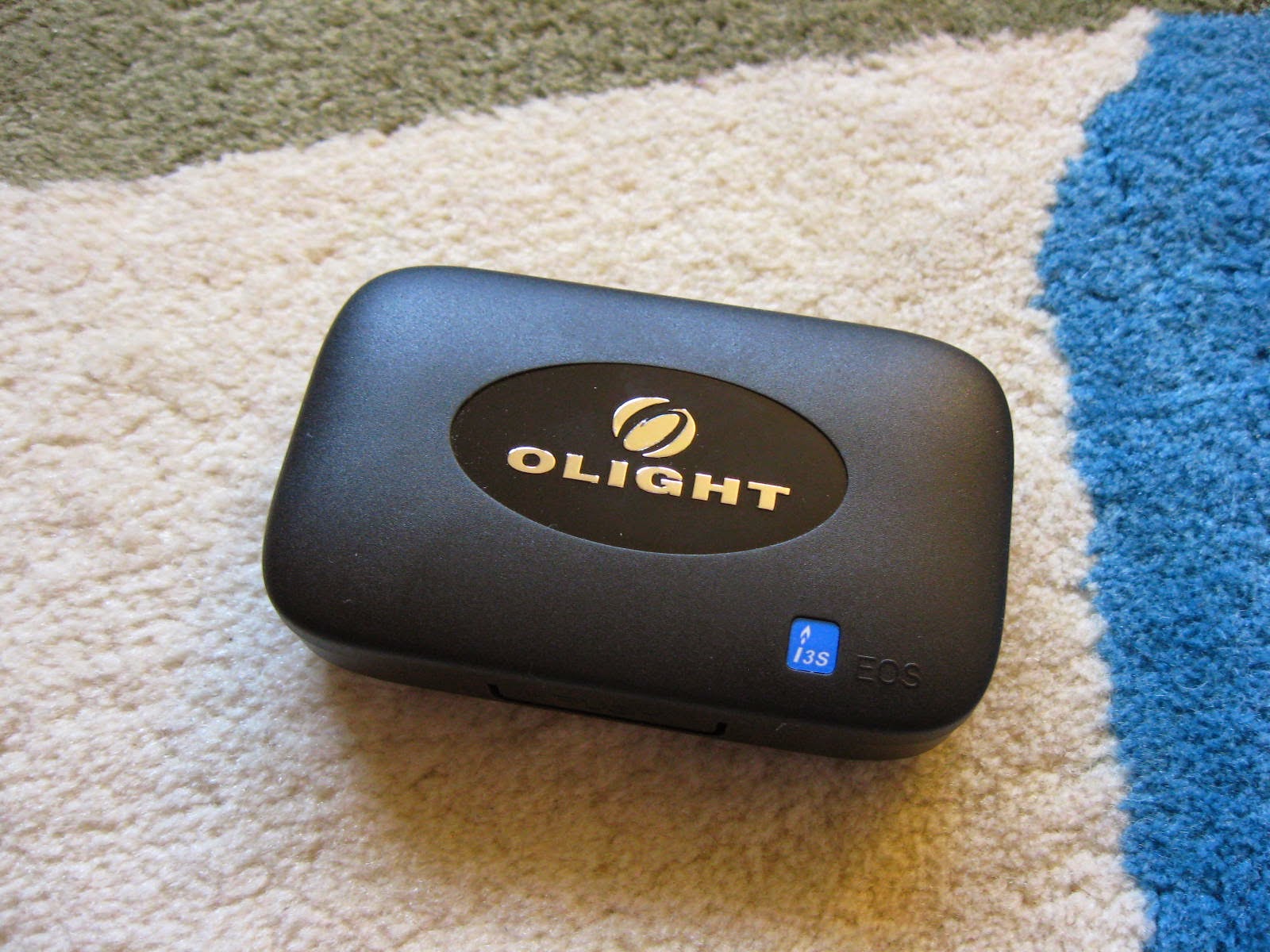
I've concluded that AAA flashlights are ideal for EDC purposes, which means that said flashlights are on my acquisition wish list. I'm still a big fan of my Olight i3S, and use it regularly. Nevertheless, I've had my eye on the Maratac torch for a while and I finally decided to buy one.
I got this little gem from CountyComm (I believe this is the only online source, but I could be wrong) for the not-quite-affordable price of about $30.00. The flashlight is solid, well-built, and works great, so perhaps the $30.00 price tag is justified. By the way, I got the basic black Rev 3 version of the flashlight, which is the latest and greatest model as of this writing.
The flashlight arrived in a plastic box, which seems to be mislabeled "Maratac Extreme" (the CountyComm website says that the Extreme is discontinued). Whatever. The description on the label is really impressive. Aircraft grade! Type III Military anodizing! Anti-Reflective lens coating! Proprietary circuit design! Reverse polarity protection! All that for the low low price of only $30.00; what a bargain!
Marketing language aside, there is a lot to like about the Maratac AAA. According to the website, the flashlight is only 2.75 inches long, with a diameter of 0.5 inches. It has a twisty UI (which is common in the flashlight world) that steps through three levels as follows: Medium-Low-High. Damn, I would gladly trade the Military grade anti-reflective reverse lens coating for a Low-Medium-High pattern. Note that the Low mode generates a fair amount of light (1.5 lumens) . . . I wouldn't call it a moonlight mode. Medium = 40 lumens, and High = 138 blinding lumens.
Although this flashlight looks all "tactical" in flat black with gnarly knurling, it does not include any of those crazy modes that you often find in tactical lights. No disco strobe light, no emergency beacon pattern, and no S-O-S mode. So, if you plan on getting lost or stranded somewhere, don't take this flashlight.
The Maratac comes with a cool glow in the dark diffuser cap, which works as advertised. I was unable to capture a good shot in the dark, so just imagine that the diffuser in the following picture is illuminated like a deployed lightsaber.
I really like, but don't love, this flashlight. It would be perfect (for my use) if the activation pattern progressed from low to high, and if the low mode was actually a moonlight level. AAA perfection is out there, I just need to find it.
Random Thoughts About Obsessive Purchasing Behavior, Acquisition Disorder, and Analysis Paralysis
Showing posts with label everyday carry (EDC). Show all posts
August 18, 2014
April 27, 2014
Olight i3S Flashlight
Flashlights. I like them, use one almost every day, and I've written about three of my flashlights before (link is here). The EagleTac D25A Mini flashlight mentioned in that post is a nice torch, but for various reasons I don't carry it often. Reason 1: my front left jeans pocket is where I carry my flashlight and my phone, and there isn't enough room to comfortably carry the EagleTac (it's a fat AA light). Reason 2: the butt end of the EagleTac has a "sharp" edge that scratches my baby soft hand skin from time to time when I reach into my pocket. Reason 3: I find that my smaller AAA flashlights generate more than enough output for my everyday needs.
What does all of this mean? Why, a new AAA flashlight of course. I've had this little gem for a while, but have been too lazy/busy to write about it. I've carried and used it enough to say with utmost certainty: "the Olight i3S AAA flashlight is very nice."
The i3S is an update of Olight's i3 flashlight, which had some shortcomings. The i3S is available in several different colors, including the shiny blue version I acquired. Features and specs of interest include: Cree XP-G2 LED emitter; three output modes (0.5 lumen moonlight mode; 20 lumen low mode; and 80 lumen high mode); snap-on pocket clip; keychain. The Internet tells me that the i3S goes for about $25.00 (as of April 2014).
The i3S is very compact. It is about 70 mm long, and it's noticeably shorter than my Preon P1 (also a AAA flashlight).
What's to like about the i3S? I personally like the reversible clip, which can be handy when I need to fashion a headlamp out of a baseball cap. The keychain is nice and sturdy, although I removed mine. The back end of the i3S is flat (good for tailstanding) and it has a smooth rounded edge that plays nice with my soft and supple skin.
What does all of this mean? Why, a new AAA flashlight of course. I've had this little gem for a while, but have been too lazy/busy to write about it. I've carried and used it enough to say with utmost certainty: "the Olight i3S AAA flashlight is very nice."
The i3S is an update of Olight's i3 flashlight, which had some shortcomings. The i3S is available in several different colors, including the shiny blue version I acquired. Features and specs of interest include: Cree XP-G2 LED emitter; three output modes (0.5 lumen moonlight mode; 20 lumen low mode; and 80 lumen high mode); snap-on pocket clip; keychain. The Internet tells me that the i3S goes for about $25.00 (as of April 2014).
The i3S is very compact. It is about 70 mm long, and it's noticeably shorter than my Preon P1 (also a AAA flashlight).
| AAA Battery, i3S, Preon P1 |
I really like the moonlight mode of the i3S, which outputs a mere 0.5 lumens. Some may think that 0.5 lumens is useless, but I think it's a great option for times when you don't need a strong blast of light. My only gripe is that it takes three twists to reach the moonlight mode . . . the twisty UI of the i3S cycles through the following sequence: Low > High > Moonlight > Low > High > Moonlight > Strobe. I understand why the sequence begins with Low, but I kinda wish it started on Moonlight. Don't get me started on the ridiculous Strobe mode. Oh well, perfection is hard to find.
| Small Things Come In Small Packages |
One final note. Olight packages the i3S in a cool plastic box that includes a AAA battery. This is a nice touch, although simpler packaging might result in a lower price point. Whatever, for $25.00, the i3S is a great buy. Overall, I'm impressed and very satisfied with the i3S.
September 2, 2013
New Phone = EDC Nightmare!
I consider myself to be a person who likes to keep up with new technology, gadgets, and electronic equipment. That said, I had been using an ancient Motorola flip phone for ages because it worked great, it held a charge for a week, and I rarely NEEDED anything other than basic voice service and basic text messaging. Don't misunderstand, I had always WANTED a modern smartphone, but I hated (and still hate) the pricing schemes that are forced down customers' throats.
Anyway, for a number of reasons I finally had to upgrade. I chose the Droid Mini by Motorola, and I'm happy with the decision even though I have nothing as a baseline for comparison. Here's a picture of the phone:
Even though this phone is relatively compact (about the same size as the ubiquitous iPhone), it has created an issue for my usual EDC scheme. My typical EDC loadout includes: wallet; phone; keys; knife; flashlight; compact pen; and pocket notebook. I had a good, dependable, and well-thought pocket assignment back in the good old pre-smartphone days. Wallet in one back pocket, notebook in the other back pocket, keys in a front pocket or hanging from a belt loop, knife in the right front pocket (tip-up carry of course; tip-down is for losers), flashlight in the left front pocket, and the pen in the coin pocket (or wherever if I'm not wearing jeans). This worked well for me, regardless of the size of the knife (within reason) carried, regardless of the size of the flashlight (again, within reason) carried, and regardless of the particular pair of pants/shorts worn that day.
That leaves the phone. When life was simple and phones were tiny, I carried my phone in a belt holster. Dork accessory? Useful and convenient? Geek flair? Yes; all of the above. My belt-carried phone meant that it was always at the ready, quick to access and deploy, and easy to hear. Plus, I mastered the one-handed action of unholstering, flipping, and answering the phone. Seriously - ring to talk within milliseconds.
The Droid Mini is small, but nobody in their right mind would hang it from their belt. I don't use a man purse and I rarely use a briefcase or messenger bag. Consequently, I had to rethink my tried and true EDC scheme to accommodate my new phone.
Take a look at the above picture. It doesn't look like much, but it is. The main issue is that I really want the phone to have its own pocket that will usually be void of keys, coins, and other objects that could damage or scratch the screen. Moreover, I don't like keeping it in my back pocket because I don't want to lose it or sit on it and break it. I could probably keep it in my left front pocket along with the pen or a small flashlight, but there's no way I'd be able to pocket both the phone and a larger flashlight or knife.
Now I'm thinking about ditching the pen and the notebook altogether. I don't use them that often, and the phone can be used in an emergency to dictate or write down important notes (e.g., "buy new flashlight" or "research blue-gray fountain pen ink"). That would definitely lighten and simplify my EDC load. I could streamline things down to the bare essentials: wallet + phone + keys + knife + light = no fun. As an alternative, I could stop carrying my "large" lights and knives and limit myself to AAA lights and blades that are less than 2.5 inches long. As an extreme measure, I could drop the flashlight from my EDC set and rely on an Android flashlight app instead. I don't think they have a Spyderco knife app, so I'll keep carrying mine, thank you very much.
You know, as of this writing I'm still within the 30-day return period of the Droid Mini. It's not too late to make a U-turn and re-holster my flip phone.
Anyway, for a number of reasons I finally had to upgrade. I chose the Droid Mini by Motorola, and I'm happy with the decision even though I have nothing as a baseline for comparison. Here's a picture of the phone:
| Droid Mini |
That leaves the phone. When life was simple and phones were tiny, I carried my phone in a belt holster. Dork accessory? Useful and convenient? Geek flair? Yes; all of the above. My belt-carried phone meant that it was always at the ready, quick to access and deploy, and easy to hear. Plus, I mastered the one-handed action of unholstering, flipping, and answering the phone. Seriously - ring to talk within milliseconds.
The Droid Mini is small, but nobody in their right mind would hang it from their belt. I don't use a man purse and I rarely use a briefcase or messenger bag. Consequently, I had to rethink my tried and true EDC scheme to accommodate my new phone.
| Everyday Confusion |
Now I'm thinking about ditching the pen and the notebook altogether. I don't use them that often, and the phone can be used in an emergency to dictate or write down important notes (e.g., "buy new flashlight" or "research blue-gray fountain pen ink"). That would definitely lighten and simplify my EDC load. I could streamline things down to the bare essentials: wallet + phone + keys + knife + light = no fun. As an alternative, I could stop carrying my "large" lights and knives and limit myself to AAA lights and blades that are less than 2.5 inches long. As an extreme measure, I could drop the flashlight from my EDC set and rely on an Android flashlight app instead. I don't think they have a Spyderco knife app, so I'll keep carrying mine, thank you very much.
You know, as of this writing I'm still within the 30-day return period of the Droid Mini. It's not too late to make a U-turn and re-holster my flip phone.
June 7, 2013
My Newest EDC Light: EagleTac D25A Mini
I don't know why it's taken me so long to write a post about a flashlight. I paid lip service to my Photon X-Light Micro and FourSevens Preon P1 flashlights in a previous post, but I didn't really say much about them. So, before I get to the EagleTac D25A Mini, I'll give a quick flashlight backstory.
The Preon is powered by a single AAA battery, and it has a max output of 70 lumens. It has a standard twisty head UI that can be used to select low (1.8 lumens), medium (8.5 lumens), and high (70 lumens) output modes. Flashlight geeks will appreciate that the Preon uses a Cree XP-G2 LED; and, yes, many people care about such specs. The UI can also be manipulated to access the "special" strobe, beacon, and SOS modes (which I only use when I want to be annoying or when I'm demonstrating the features to someone).
I love the easy-to-use twisty UI and the basic design of the Preon. My only gripe: the finish is too silky smooth, which makes it difficult to twist on and off with one hand. I wish it had some texture or knurling at the head.
End of backstory. So what's up with the EagleTac D25A Mini? To be honest, I simply wanted to buy another flashlight. No big deal. I initially looked at other AAA lights, but soon decided on a AA light. I also considered the following AA lights before deciding to acquire the EagleTac: Maratac; Lumapower LM31; FourSevens Mini MA; and EagleTac D25A Clicky. I was about to order the titanium clicky version of the D25A, but then common sense and frugality took over.
The D25A is very small and compact. The EagleTac website tells me that the D25A is 3.1 inches long with a head diameter of only 0.69 inches. It's not that much larger than my Preon, and it also fits nicely into my pocket. I feel that the AA size of the D25A is a perfect compromise between utility and EDC capability.
The flashlight has a solid and tough pocket clip that I'll never use for its intended purpose (mine is black versus the silver colored clip shown on the EagleTac website; what's up with that?). The D25A also came with a belt holster (that I'll never use) and a lanyard with clip (that I'll never use). The end of the D25A has a slot to accommodate the lanyard clip; this allows tailstanding when the lanyard is attached.
The EagleTac D25A is compatible with AA sized batteries, including standard alkaline batteries, long life disposable lithium batteries, rechargeable NiMh batteries, and high voltage lithium ion batteries (which may result in blinding sunlight output and molten aluminum, which equals awesome). I'm using a regular AA cell at the moment, and it works just fine. I've read that better performance can be had with a Sanyo Eneloop battery, and I will give that a shot next. The housing is not much larger than the AA battery itself, as shown here:
Now, I supposedly ordered the latest and greatest version of the D25A, i.e., the one with the Cree XP-G2 R5 LED. According to the marketing department of EagleTac, this emitter generates 179 lumens on high, 47 lumens on medium, and 5 lumens on low. I am not an LED expert, nor do I care to become one. I only know these facts: this flashlight generates plenty of light for my EDC needs; the low mode is great for skulking around the house at night; and the color of the light is more of a natural and warm hue (in contrast to the Preon P1, which seems to be "cool white" in comparison).
The light uses the same type of twisty UI as the Preon P1, so it was easy for me to learn how to use it. The D25A Mini also has some "hidden" modes for strobe, beacon, and SOS. I guess these modes could be useful in certain urban emergency scenarios (flagging down the car valet at the five-star hotel, signaling for help when your mountain bike tire goes flat on the golf cart path, indicating that you've raised the bid on that rare bottle of wine, etc.). Speaking of the twisty interface, EagleTac was kind enough to provide ample knurling on the body and head of the flashlight. The knurling, combined with the protruding pocket clip, makes it very easy to operate the twisty UI with one hand. For this reason, I'll be carrying the D25A Mini more often than the Preon P1.
So that's about it for the EagleTac D25A Mini. If and when I NEED another flashlight, I'll keep the EagleTac brand in mind.
The Photon X-Light Micro was the best thing I acquired in 2011. It still resides on my keychain, with the original battery alive and kicking. I use it almost every day; it's just great to have on my keychain. I have the high-tech looking clear version, which has a glow in the dark button. Max output is 4.5 lumens according to Photon, which is sufficient for my intended use cases: finding keyholes; navigating hallways at night; and reading menus in dark restaurants.
I tend to use the Photon's simple click-on, click-off mode. The click button, however, can also be manipulated to provide a variable output level and to select different beacon and SOS modes - pretty impressive for a nine dollar light. The Photon is very well made, too. The plastic case, the split ring and the keychain clip are all very tough, and they appear to be designed to withstand the daily abuse of keychain carry. I now have one of these lights on every one of my keychains.
Next up, the FourSevens flashlight. I purchased the Preon P1 for use as my daily pocket-carry light, and it works just great for that purpose. According to FourSevens, it is only 2.95 inches long and only 0.6 inches in diameter. It's pretty small, and it really disappears in the pocket.
I tend to use the Photon's simple click-on, click-off mode. The click button, however, can also be manipulated to provide a variable output level and to select different beacon and SOS modes - pretty impressive for a nine dollar light. The Photon is very well made, too. The plastic case, the split ring and the keychain clip are all very tough, and they appear to be designed to withstand the daily abuse of keychain carry. I now have one of these lights on every one of my keychains.
Next up, the FourSevens flashlight. I purchased the Preon P1 for use as my daily pocket-carry light, and it works just great for that purpose. According to FourSevens, it is only 2.95 inches long and only 0.6 inches in diameter. It's pretty small, and it really disappears in the pocket.
The Preon is powered by a single AAA battery, and it has a max output of 70 lumens. It has a standard twisty head UI that can be used to select low (1.8 lumens), medium (8.5 lumens), and high (70 lumens) output modes. Flashlight geeks will appreciate that the Preon uses a Cree XP-G2 LED; and, yes, many people care about such specs. The UI can also be manipulated to access the "special" strobe, beacon, and SOS modes (which I only use when I want to be annoying or when I'm demonstrating the features to someone).
| I Can See The Cree! |
| The Preon P1 And Its Power Source |
The D25A is very small and compact. The EagleTac website tells me that the D25A is 3.1 inches long with a head diameter of only 0.69 inches. It's not that much larger than my Preon, and it also fits nicely into my pocket. I feel that the AA size of the D25A is a perfect compromise between utility and EDC capability.
| D25A Mini (Top), Preon P1 (Bottom) |
| D25A Mini (Left), Preon P1 (Right) |
Now, I supposedly ordered the latest and greatest version of the D25A, i.e., the one with the Cree XP-G2 R5 LED. According to the marketing department of EagleTac, this emitter generates 179 lumens on high, 47 lumens on medium, and 5 lumens on low. I am not an LED expert, nor do I care to become one. I only know these facts: this flashlight generates plenty of light for my EDC needs; the low mode is great for skulking around the house at night; and the color of the light is more of a natural and warm hue (in contrast to the Preon P1, which seems to be "cool white" in comparison).
| Cree XP-G2 R5 LED |
| Grip It & Twist It |
May 23, 2013
Pocket Knives
When I was a wee lad I carried a pocket knife to be cool, carve my initials into wooden objects, and play mumblety-peg with the neighborhood degenerates. I recall having a cheap single blade folder and a medium sized Swiss Army Knife way back when. However, I stopped carrying pocket knives after getting out of high school (yeah, back then pocket knives were allowed in school), and never really missed them or gave them much thought until a few years ago.
So what happened a few years ago? I was on a weekend hike with another family, and my friend broke out an absolutely enormous Swiss Army Knife that I immediately ridiculed and scoffed at. No, it wasn't THIS monstrous, but still. After getting my friend on the defensive, he explained all about the practical utility of having an EDC pocket knife: sawing logs for a lean-to; spontaneous tooth picking; and blah blah emergencies blah blah. He was very convincing. So, I dug my old Swiss Army Classic out of my drawer and started to carry it on the regular. I soon decided to get something different, and that led to the acquisition of a Buck Scholar knife.
KAD took over in 2012, and I really went haywire that year. My knife purchases went like this: Spyderco Dragonfly2 in May; Spyderco Manix2 Blue Lightweight in June; Benchmade Mini-Griptilian in July; Coldsteel Tuff Lite in August; Gerber Dime in November (returned to Amazon in November); Leatherman Juice S2 in early December; and Spyderco Native5 ordered on December 31, 2012. Wow, that's a little overboard, but the lineup looks great:
The knives are shown in chronological order according to when I got them: top row left to right, then bottom row left to right. So my oldest knife is the SAK Classic, and my newest is the Native5. I don't really carry the Classic or the Scholar these days, simply because I prefer the other knives as EDC items. I rarely carry the Manix2 because I don't want to scare or intimidate any sheeple in the neighborhood. Seriously, the Manix2 is only a "pocket" knife in theory or if you're rockin' giant baggy MC Hammer pants.
I guess that I can do some retroactive posts related to the Dragonfly2, Manix2, and Mini-Griptilian knives. So be on the lookout for those posts. Unless, of course, KAD kicks in again and/or a Sebenza magically appears in my mailbox. If that happens, I'll write about it immediately.
April 13, 2013
Leatherman Juice S2
As I wrote in an earlier post, my first multitool (the Gerber Dime) was a multifail. I returned the Dime the day after I received it, and immediately began the acquisition process to identify a better product. As soon as I returned it, I knew that I would be looking for a Leatherman multitool. I looked at the different Leatherman models and decided to get one of the pocket sized multitools. The Skeletool models look super cool, but they have limited functionality. Ditto for the Freestyle model. After eliminating those models, I was left with the different Juice models. From there it was easy for me to pick the Juice S2 model because it has scissors in lieu of a corkscrew. I don't drink wine, and consider a corkscrew to be a silly addition to a multitool. I decided to acquire the orange version because I thought that it would be distinctive, difficult to lose sight of, and easy to locate.
The orange color is unusual, but not annoying or childish at all. I like it. I also like the awesome fit and finish of the S2, which blows away the fit and finish of the Gerber Dime that I had.
My original intent was to EDC the S2 for a month to see whether or not I would ever need to use any of the tools other than the knife or the scissors. Speaking of EDC, the S2 is small and light enough to EDC, although for me it pushes the envelope of what I would call "comfortable" EDC. Whether or not the S2 is too bulky or bothersome for use as an EDC item will depend on which pocket you use and how it settles into the pocket.
When I hear the word "Leatherman" I immediately envision a set of pliers. The Juice S2, as expected, includes a set of needle nose pliers that also serve as wire cutters. The clamping action and tolerances are very good; I only wish that they were spring loaded.
The above picture is my attempt at showing most of the S2's tools: phillips screwdriver; knife; scissors (look at the size of that thing!); bottle/can opener; and flat screwdrivers. Would it be nice to have some other items? Sure, but then the S2 would become bloated, heavier, and lose its primary selling point (for me at least): EDC functionality. By the way, the S2 can also be configured into a Transformer-like bipedal Edward Scissorhands thing:
This is an unadvertised benefit and function of the S2 that brings the tool count up to thirteen in my book. Anyhow, I got the Juice S2 in early December 2012 and didn't use anything other than the knife and scissors for a good while. Fast forward to Christmas day, and I had an opportunity to deploy the pliers, the phillips driver, and a flathead driver. I also used the scissors and the knife to break down some boxes. To be honest, I could have used a corkscrew to open a bottle of wine for some guests, but whatever.
As mentioned above, my goal was to to EDC the S2 for a month or so to determine whether or not it makes sense to carry all of that functionality around. Well, the S2 didn't last an entire month. The day after Christmas, I needed a phillips screwdriver to install some batteries in my kid's toy. I made a point to announce to all the EDC disbelievers in the house: "it sure would be nice if I had a screwdriver on me . . . wait a second, I DO happen to have one right here in my . . . hey, where's my Leatherman?" It wasn't in my pocket, it wasn't in my EDC valet tray, and it wasn't in the garage near the boxes that I had broken down. I swore that I placed it in an unforgettable place after breaking down the boxes. Where did I put it? Why, on the back bumper of the car! Brilliant.
Unfortunately, my bright orange Juice S2 was not covered with a grippy rubbery exterior coating. Nor was it outfitted with an ultra heavy duty magnet. Accordingly, it fell off the bumper on the way to the local wine shop. I retraced my drive in an attempt to find the S2 in the street, but the distinctive and conspicuous orange sheen did nothing for me. Meh.
Anyway, I really enjoyed and liked the S2 during the few weeks we had together. I'm glad that I captured some pictures of it before I lost it.
PS - I acquired another Juice S2 a couple of months ago. I got the gray colored model and haven't lost it yet.
The orange color is unusual, but not annoying or childish at all. I like it. I also like the awesome fit and finish of the S2, which blows away the fit and finish of the Gerber Dime that I had.
My original intent was to EDC the S2 for a month to see whether or not I would ever need to use any of the tools other than the knife or the scissors. Speaking of EDC, the S2 is small and light enough to EDC, although for me it pushes the envelope of what I would call "comfortable" EDC. Whether or not the S2 is too bulky or bothersome for use as an EDC item will depend on which pocket you use and how it settles into the pocket.
When I hear the word "Leatherman" I immediately envision a set of pliers. The Juice S2, as expected, includes a set of needle nose pliers that also serve as wire cutters. The clamping action and tolerances are very good; I only wish that they were spring loaded.
The above picture is my attempt at showing most of the S2's tools: phillips screwdriver; knife; scissors (look at the size of that thing!); bottle/can opener; and flat screwdrivers. Would it be nice to have some other items? Sure, but then the S2 would become bloated, heavier, and lose its primary selling point (for me at least): EDC functionality. By the way, the S2 can also be configured into a Transformer-like bipedal Edward Scissorhands thing:
This is an unadvertised benefit and function of the S2 that brings the tool count up to thirteen in my book. Anyhow, I got the Juice S2 in early December 2012 and didn't use anything other than the knife and scissors for a good while. Fast forward to Christmas day, and I had an opportunity to deploy the pliers, the phillips driver, and a flathead driver. I also used the scissors and the knife to break down some boxes. To be honest, I could have used a corkscrew to open a bottle of wine for some guests, but whatever.
As mentioned above, my goal was to to EDC the S2 for a month or so to determine whether or not it makes sense to carry all of that functionality around. Well, the S2 didn't last an entire month. The day after Christmas, I needed a phillips screwdriver to install some batteries in my kid's toy. I made a point to announce to all the EDC disbelievers in the house: "it sure would be nice if I had a screwdriver on me . . . wait a second, I DO happen to have one right here in my . . . hey, where's my Leatherman?" It wasn't in my pocket, it wasn't in my EDC valet tray, and it wasn't in the garage near the boxes that I had broken down. I swore that I placed it in an unforgettable place after breaking down the boxes. Where did I put it? Why, on the back bumper of the car! Brilliant.
Unfortunately, my bright orange Juice S2 was not covered with a grippy rubbery exterior coating. Nor was it outfitted with an ultra heavy duty magnet. Accordingly, it fell off the bumper on the way to the local wine shop. I retraced my drive in an attempt to find the S2 in the street, but the distinctive and conspicuous orange sheen did nothing for me. Meh.
Anyway, I really enjoyed and liked the S2 during the few weeks we had together. I'm glad that I captured some pictures of it before I lost it.
PS - I acquired another Juice S2 a couple of months ago. I got the gray colored model and haven't lost it yet.
November 27, 2012
My Two Cents on the Gerber Dime
I've wanted a Leatherman multitool thingy for many years, but never pulled the trigger on one because my desire to own one had been driven primarily by the "cool factor" more than the "hey, I could really use a multitool on a daily basis" factor. That said, I've recently changed my attitude about multitools and I convinced myself to buy one for the "just in case you need pliers or a screwdriver in an emergency" factor. That fresh outlook ultimately led me to the Gerber Dime keychain sized multitool.
Once I convinced myself that a multitool must be acquired, I did some research and price comparisons. I was browsing the offerings on the Leatherman website and got a little overwhelmed with all of the different models. So I did what I always do: checked out some online multitool reviews. I went straight to the reviews posted on the awesome Everyday Commentary blog, focused on the highest rated products, and was impressed with this stellar review of the Gerber Dime. Once I saw the 20/20 score, I was sold.
I purchased the Dime from the evil empire known as Amazon (free shipping with my Prime status) for less than $17.00 . . . "not bad" I thought. When I received it a few days later, I was surprised at its tiny size. The Dime truly is an EDC keychain-carry item. I was also surprised that the product looked like a pre-owned item. For example, the printed lettering on the scales was scuffed up and shoddy looking out of the box. Not really a deal breaker, but also not a great first impression.
Of course, I immediately started to fiddle with the Dime in an attempt to discover all of its useful features. Scissors: check (easy to deploy, well made, cuts paper). Knife: check (easy to deploy, sharp enough, interesting blade shape). Flat screwdriver: damn, that thing is jammed in there, let me try again; damn, I just chipped off my thumbnail, let me try again; WTF this thing sucks, does anyone have a Leatherman that I can use to open this screwdriver? Package opener tool: ditto (now there are two shards of thumbnail on the table next to the Dime). File: check (somewhat easy to deploy, and it came in handy to tune up my jagged and severed thumbnail).
| I Used This! Twice! |
The Dime also has something that is advertised as tweezers. Unfortunately, the tweezers are not very useful because they are biased in the closed position. Fortunately, I was able to use the end of the file as a pry bar to tweak and bend the tweezers open. After performing this tweezers mod, I used them to pick up and discard my thumbnail shards. Alas, the mod was only temporary; the tweezers returned to the closed position after I slid them back into their retaining slot. The tweezers in my little Swiss Army Knife are much better, and they work as intended without modification.
The pliers are well-designed, easy to deploy and fold, and have a nice spring action to them. I can't really complain about the pliers, and I'm tempted to keep the Dime simply for this nice feature. Tempted, but not convinced.
The Dime also has an exposed bottle opener and a split ring for a keychain. I didn't use either of them, but I assume that they work fine. Here's a picture of the Dime in all of its glory:
I honestly think that I may have gotten a unit that was made on a Monday or a Friday, because I refuse to believe that every Dime has tools that are virtually impossible to deploy and/or use properly. It's a shame, because this multitool has an impressive set of features, it looks great, and it seems to be solidly built (other than the tweezers).
These pictures will be saved, but the Dime is going back to Amazon. First impressions go a long way with me, and the Dime just doesn't make the cut. I still want to get a multitool to keep in my car, so it looks like I'll be navigating the Leatherman website again real soon.
September 7, 2012
EDC Pens
If you look carefully in the stack o' pens shown in this previous post, you might see the four compact little pens in the picture to the right. I bought these pens (coincidentally, all of them are Zebra brand pens) in an attempt to find a decent EDC item to keep with me in my pocket, on my keychain, etc.
Yeah, yeah, I know about the super popular Inka keychain pen, but have some reservations about it (after spending a few days reading online reviews of it, as though it's a luxury vehicle or a major appliance). Instead, I opted for the following, shown left to right in the picture: Zebra F-301 Compact ballpoint; Zebra Minna Mini ballpoint; Zebra SL-F1 Mini ballpoint; and Zebra Penpod ballpoint.
The F-301 Compact is based on the regular F-301, which is good for a ballpoint. It has a lanyard hole to accommodate keychain carry, but I think it's too long to keep with my keys in my pocket. When closed, the cap is very secure, but when posted on the end it is really wobbly and shaky. When the cap is posted, the pen is virtually a full sized pen. This makes it comfortable to write with, but an EDC pen for me will typically be used only for quick notes and reminders. All of these factors put the F-301 Compact in last place for me.
The Minna is super thin and compact, and I like the design even though it's a little feminine. It might be tough to see in the picture, but there is a very cool Japanese style graphic in a clear window section of the barrel. The body is very thin, and most of the pen fits inside the cap when closed. I like how the ends are rounded and the thin body makes this easy to keep in my jeans coin pocket.
I'll take the SL-F1 Mini for the win here. This pen is weighty (I believe it has a metal construction), compact, and sleek. The gray color is nice, and it does come in other colorways. The pen telescopes to reveal the tip and to extend the body. The extended length is somewhat short, but still OK to write with for a quick note or two. When closed, it fits perfectly in my jeans coin pocket. Moreover, pen has a deep carry clip configuration, which I like better than the shallower clip found on the Minna.
The Penpod is a good option if you really want to carry something on your keychain. I don't, and the girth and deployment mechanism of the Penpod make it less than perfect for pocket carry. The pen itself is spring loaded and a quick twist releases it from the cap, which stays on the keyring.
So I wasted a few dollars and a whole lot of online research time to realize that the Zebra SL-F1 is nearly perfect for my needs. It usually lives in my jeans coin pocket (or in some other pocket when I'm not wearing jeans) and it's so small that I don't even notice it.
September 3, 2012
New Pocket Knife: Cold Steel Tuff Lite
Rather than "review" this knife, I'll just point out some features that led me to buy it. First, I wanted to try a different/unusual blade shape. This knife has a Wharncliffe blade shape (yes, I learned a new word) that is characterized by the straight cutting edge and the curved top edge. I like this shape because I often use my knife to open packages and unruly envelopes, and the blade works well for those applications. Second, I like the way it looks when the blade is open. Third, I wanted to try a different brand (I already have a Spyderco and a Benchmade).
The knife is somewhat portly when closed. It's probably the thickest knife I own as of today. I like the look of this knife when closed, but it really looks great when open. The curved "turtle shell" profile is different than any other knife I own.
Although impossible to tell from my pictures, the blade is hollow ground, and it is literally razor sharp. The straight cutting edge will be perfect for all of my extreme box-cutting chores lol. If I ever encounter a particularly menacing box, those super well-defined finger choils (yet another word recently added to my vocabulary) should do the trick!
August 23, 2012
Valet Tray
This is a perfect example of the acquisition snowball effect. I've recently become slightly interested in the EDC concept, which basically means that you ought to carry as much usually-needless crap on your person to be prepared for those unusual situations where you actually need that crap. So, instead of merely carrying a wallet, keys, a few coins, and a phone on a daily basis, my EDC haul now includes an assortment of gear. I used to stash EVERYTHING on a little keychain shelf in the hallway. Life was simple back then (OK, just a few months ago, but whatever). Simple. Well, I outgrew that little shelf and didn't like seeing all of my EDC items randomly strewn on the counter top, my dresser, my nightstand, etc. Problem solved with a quick visit to Amazon (have I mentioned that Amazon Prime is the Devil?), where I found this here "Ryan 10" Valet Tray" for a more than reasonable $17.95.
OK, "valet tray" is just a manly way of saying <cough cough> "jewelry box" for man gear; I get it. Note that I was actually about to pull the trigger on a more ridiculous tray that was closer to $50.00, but in a moment of strength and power overcame my usual compulsive purchasing behavior and "settled" for the less expensive and more practical item you see in the picture.
As you can see, my friend Ryan has a few stash pockets, one larger pocket with a lid, and a coin compartment that looks like a micro skateboarding halfpipe. The curved profile makes it easier to swipe your coins outta there - brilliant! Now everyone is happy, and each EDC item has its own little home away from me.
| This is Ryan |
As you can see, my friend Ryan has a few stash pockets, one larger pocket with a lid, and a coin compartment that looks like a micro skateboarding halfpipe. The curved profile makes it easier to swipe your coins outta there - brilliant! Now everyone is happy, and each EDC item has its own little home away from me.
August 12, 2012
EDC = Every Day Carry
I may need a guest writer for this entry because I am an absolute EDC novice. Most people have at least one EDC item on their person: car keys; a wallet; a phone; a prophylactic device (kids, don't ask); etc. I'm here to tell you that one item is not enough. According to well established EDC principles, you must keep on your person as much as humanly possible. Every. Day. To demonstrate, the picture over there to the right is exactly what my keychain looked like back in October 2011. I didn't carry anything else other than my wallet and phone. In fact, my theory at that time was "less is more." These days, "more is more."
October 2011 is when I acquired a decent keychain flashlight: the Photon X-Light Micro. At the time, I didn't even know what the acronym "EDC" stood for (what, "Electronic Direct Current"?). Nor did I care . . . I just needed a damn light to find keyholes and avoid walking into scooters, basketballs, rocks, Beyblades, and skateboards on the way to my car. The little light also proved to be very useful for certain situations, i.e., scenarios where one might say something like "I need some light." This light remains on my keychain to this day, as shown in my loadout picture.
Let me be clear that carrying a boad load of crap is a 180 degree paradigm shift for me because until very recently I liked the streamlined feel that empty pockets provide. In fact, my EDC gear is still fairly minimalist in comparison to the stuff carried by real EDC junkies such as the nice folks over at EDC Forums or the people who show off their gear on Everyday-Carry.Com. Honestly, my stuff is realistic and reasonably practical for MY needs. I'm not a mechanic, I don't work outdoors, and I'm not in law enforcement. I don't need a pry bar or a pistol. I don't climb mountains and, therefore, don't need a rope cinching device. Sometimes I wish I was a border patrol car mechanic by day slash search and rescue volunteer by night so that I could rationalize more EDC gear, but "computer staring desk monkey" is reality. That reality doesn't call for much in the EDC department.
In the second picture, from left to right: keychain with Photon X-Light Micro and an HP USB drive; Moleskine softcover pocket notebook; Benchmade Mini-Griptilian knife; Zebra SL-F1 ballpoint pen; and FourSevens Preon P1 flashlight. Not shown are my wallet and phone (which I'm embarrassed to show because it's lame). I tend to unload my keychain when I'm at work or at home, which is why I always carry the Preon P1 flashlight in my pocket. I have other knives that I switch out from week to week, but I always try to keep at least one on me at all times, because that is the tool that gets the most use. For example, that knife was used to open the Amazon boxes for the USB drive, the Preon, and the Moleskine.
So that's a quick summary of how the EDC concept has invaded my life. Are there any essential items that I'm missing?
October 2011 is when I acquired a decent keychain flashlight: the Photon X-Light Micro. At the time, I didn't even know what the acronym "EDC" stood for (what, "Electronic Direct Current"?). Nor did I care . . . I just needed a damn light to find keyholes and avoid walking into scooters, basketballs, rocks, Beyblades, and skateboards on the way to my car. The little light also proved to be very useful for certain situations, i.e., scenarios where one might say something like "I need some light." This light remains on my keychain to this day, as shown in my loadout picture.
Let me be clear that carrying a boad load of crap is a 180 degree paradigm shift for me because until very recently I liked the streamlined feel that empty pockets provide. In fact, my EDC gear is still fairly minimalist in comparison to the stuff carried by real EDC junkies such as the nice folks over at EDC Forums or the people who show off their gear on Everyday-Carry.Com. Honestly, my stuff is realistic and reasonably practical for MY needs. I'm not a mechanic, I don't work outdoors, and I'm not in law enforcement. I don't need a pry bar or a pistol. I don't climb mountains and, therefore, don't need a rope cinching device. Sometimes I wish I was a border patrol car mechanic by day slash search and rescue volunteer by night so that I could rationalize more EDC gear, but "computer staring desk monkey" is reality. That reality doesn't call for much in the EDC department.
In the second picture, from left to right: keychain with Photon X-Light Micro and an HP USB drive; Moleskine softcover pocket notebook; Benchmade Mini-Griptilian knife; Zebra SL-F1 ballpoint pen; and FourSevens Preon P1 flashlight. Not shown are my wallet and phone (which I'm embarrassed to show because it's lame). I tend to unload my keychain when I'm at work or at home, which is why I always carry the Preon P1 flashlight in my pocket. I have other knives that I switch out from week to week, but I always try to keep at least one on me at all times, because that is the tool that gets the most use. For example, that knife was used to open the Amazon boxes for the USB drive, the Preon, and the Moleskine.
So that's a quick summary of how the EDC concept has invaded my life. Are there any essential items that I'm missing?
August 5, 2012
Pens!
What: A ridiculous amount of pens (and a token mechanical pencil).
When: Purchased and collected during the last few weeks.
Why: LOL, this might take some time to explain.
The seed of this irrational interest in pens can be traced to a discussion I had with a friend regarding EDC (Every Day Carry) items. He mentioned that he always carries a writing instrument on his person, you know, "just in case." His weapon of choice these days is the Pentel Sharp Kerry mechanical pencil. He showed it to me, and I was immediately sucked in. Long story short, I bought one for use at the office to replace the disposable, and pretty much worthless, mechanical pencil that I had been using. Long story long, this got me thinking about "upgrading" the standard issue pens that my office provides (Uni-Ball Micro Rollerball pens). I had long grown tired of their inconsistent performance, random wet/dry ink scenarios, and ink blobs on my papers, but never thought twice about them. I decided to take the red pill so to speak, and took a trip to Staples to check out their pen selection.
How: Until a few weeks ago I was totally and utterly clueless about pen ink and pen technology. For example, I thought that "gel" in the context of a pen meant that the pen had a squishy jelly-like finger grip on the barrel. Seriously. Staples set me straight. I now realize that "gel" is a type of ink, along the lines of ballpoint ink versus liquid rollerball ink versus gel ink versus fountain pen ink. Anyhow, I picked up a small assortment of pens at Staples, including some ballpoints, some gels, and some "hybrid" ink pens (Uni-Ball Jetstream pens). After test driving this first batch, I entered the deep dark world of Internet pen blogs/forums (see, e.g., The Pen Addict) to read reviews in an attempt to find the best pen for daily use at the office. Down the slippery slope we go to discover more and more blogs (Office Supply Geek) and even some e-commerce sites that are DEVOTED to pens (JetPens and Tokyo Pen Shop), and here we are. The aforementioned sites are full of descriptions, pictures, and reviews of various pens, pencils, and writing instruments. I don't intend to do the same, but might provide some thoughts and comments soon, because I'm still in the process of testing pens, finding new ones to buy, etc. I haven't even started down the fountain pen path, which I know will just consume my life eventually.
Subscribe to:
Posts (Atom)